
Warpath
An American Western masterwork previously lost to time — a rediscovered Russell oil believed to have originated from the artist's 1914 London exhibition, returning to public view after more than half a century in storage.
A rediscovered Western masterwork.
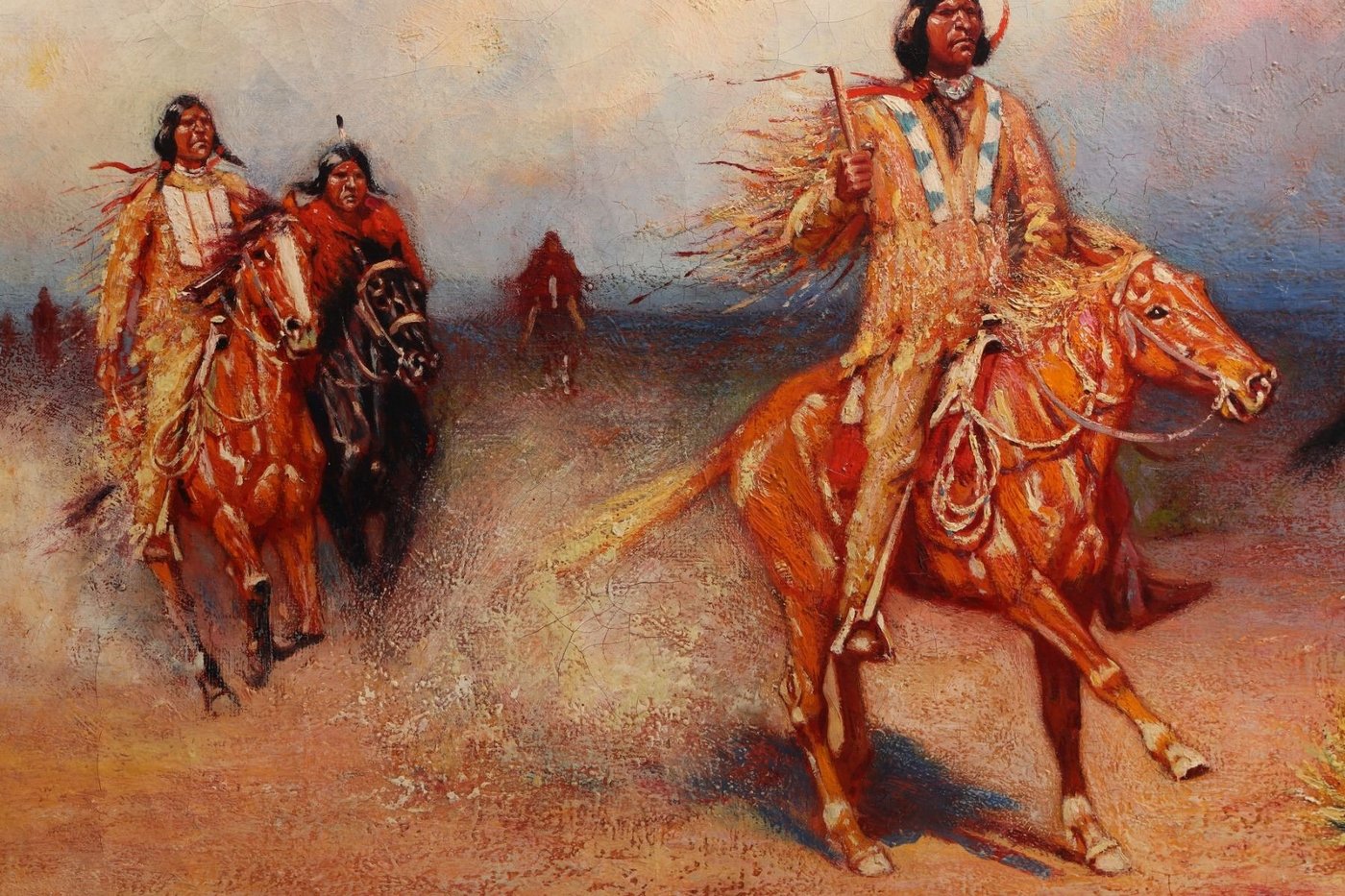
This vibrant, dynamic Western scene — a procession of mounted Native American figures in the dust-hazed frontier — bears all the hallmarks of Charles Marion Russell's mature style. Executed with competent, gestural brushwork and a careful attention to atmospheric realism, the painting was rediscovered after more than half a century in private storage in London and Nevada.
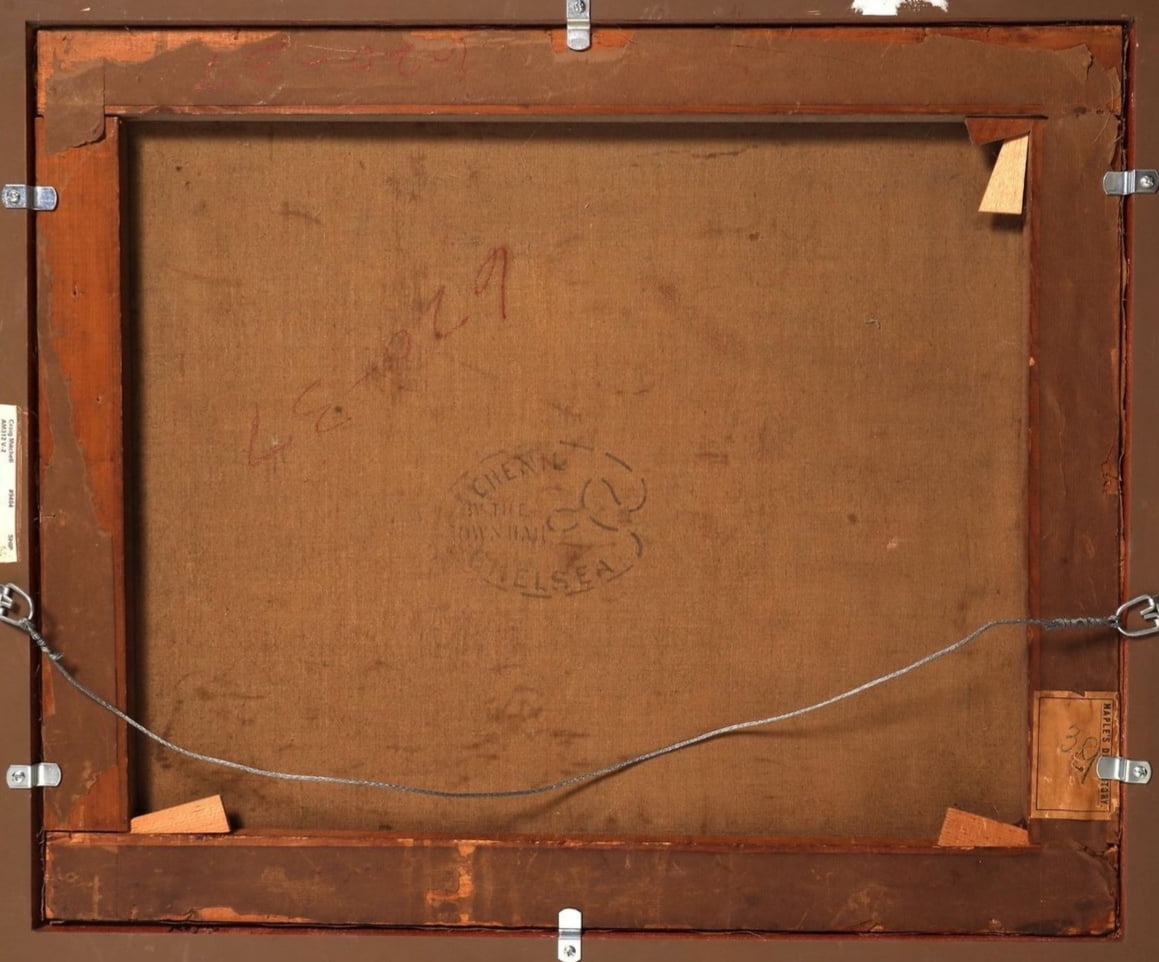
A 1965 attribution letter from British artist and academic Paul Curtis (Royal Academy of Arts, London) describes the painting as Warpath, attributing it to Russell and referencing a period during which the work was held in a London private collection. Storage labels — most notably the Chenil stamp and the Maples Depository, London warehouse label — anchor the painting to early-twentieth-century London and to the artist's brief but consequential international exhibition career.
The 1914 Doré Gallery, London.
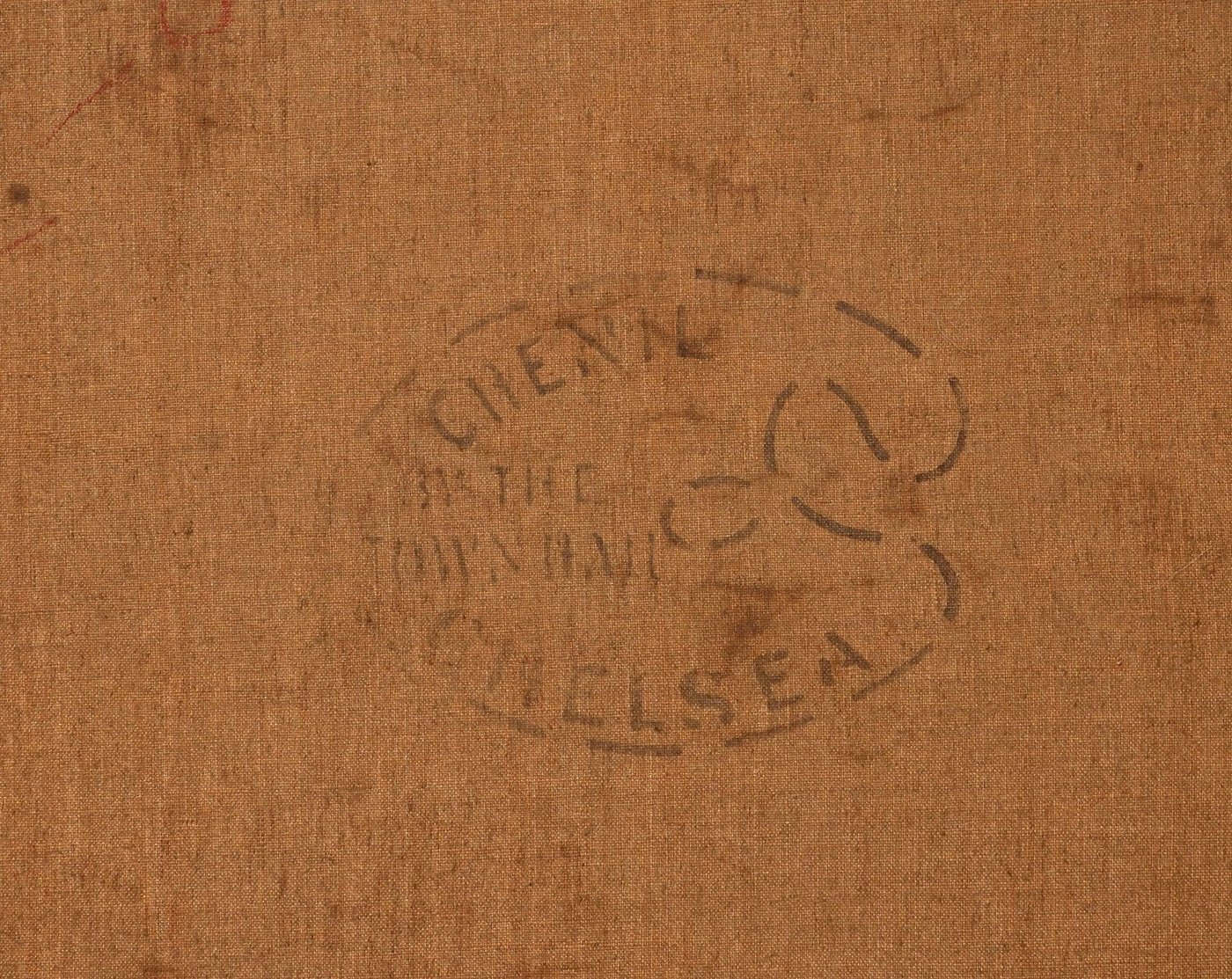
The painting's origin in early-1910s London — confirmed by both the Chenil stamp and the Maples Depository warehouse label visible on the verso — places it within a rare and important moment in Russell's career: his 1914 international exhibition at the Doré Gallery in London, his first and most ambitious step beyond the American market.
Few works survive from that London chapter. Most of the canvases Russell sent overseas have either been lost, returned to American collections through the secondary market, or remained in obscure European private hands. Warpath appears to be one of those obscure survivors — quietly held, then forgotten, then found again.
The hallmarks of Russell's mature hand.
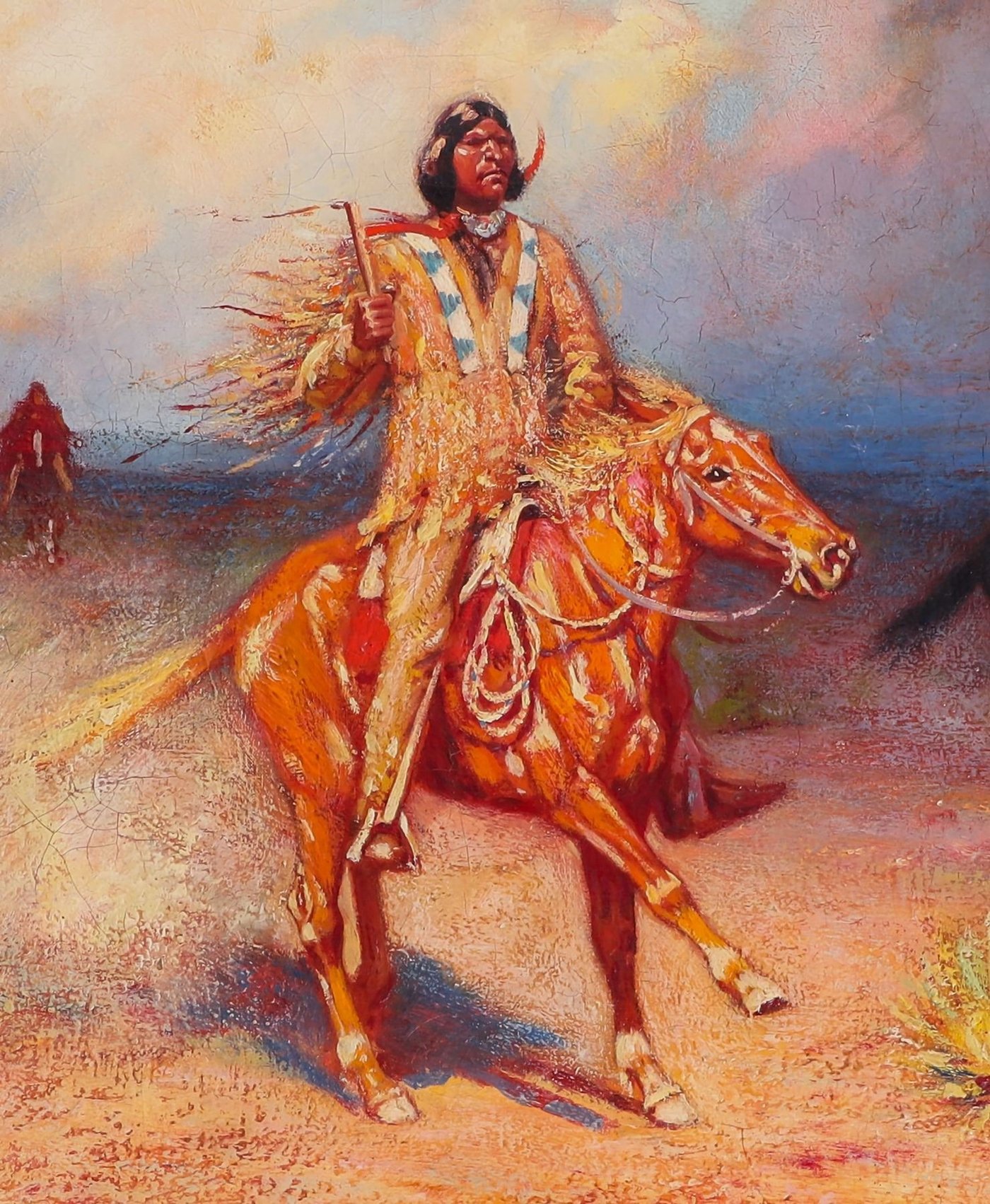
The central figure — an Indigenous man astride a powerful, dynamic horse — is rendered with the fluid brushwork and gestural energy characteristic of Russell's late oils.
Background figures are deliberately de-emphasized, a known compositional strategy Russell used to emphasize foreground action and draw the viewer into the central moment.
Dust clouds, particularly behind the galloping horses, are rendered in the murky brown hues Russell favored to convey authentic atmospheric realism — a technique he applied repeatedly to his Plains and trail scenes.
A second composition beneath the surface.
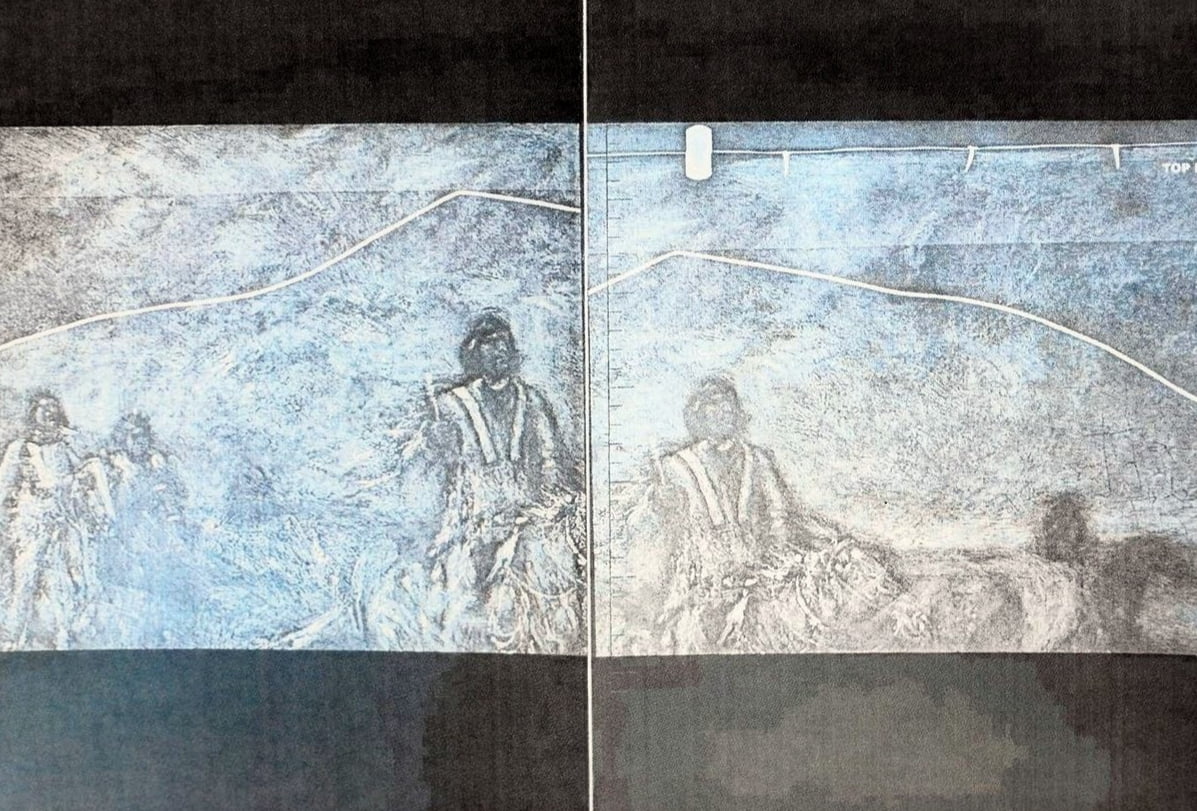
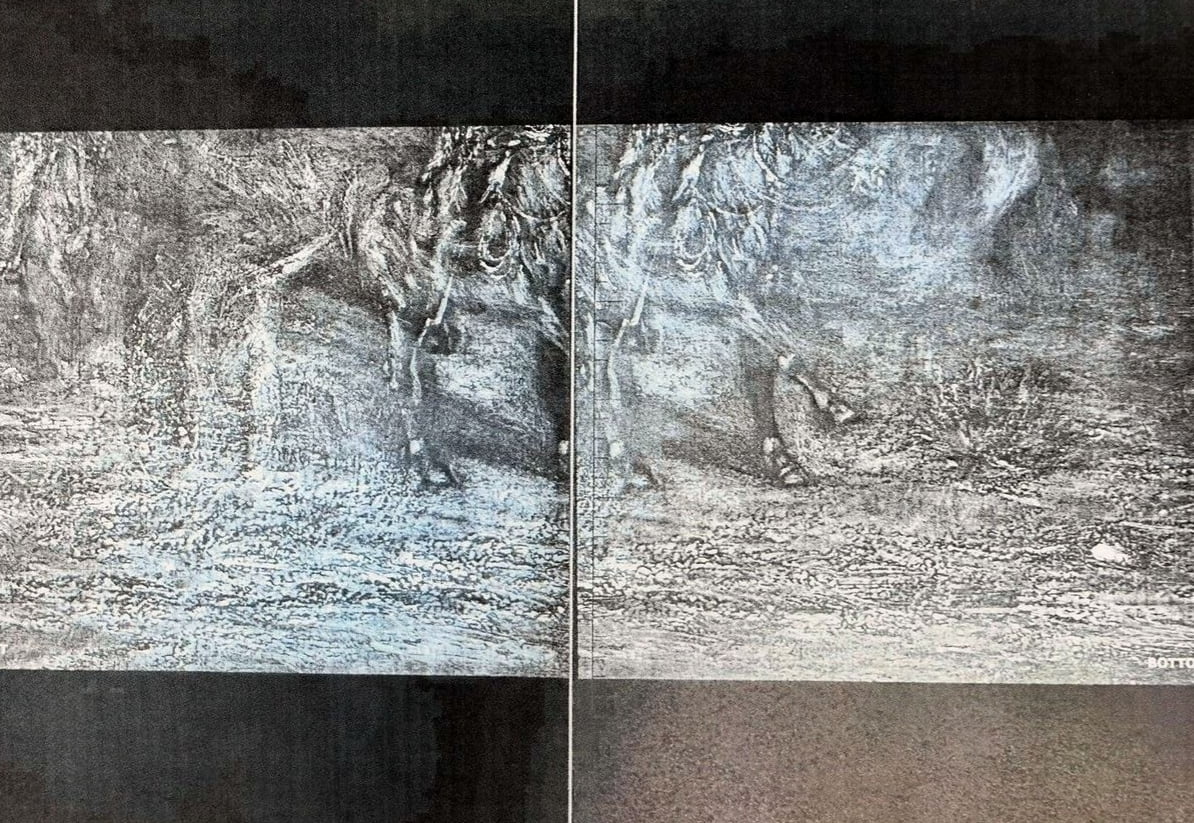
Professional X-ray imaging performed in 2024 revealed potential overpainting beneath the visible composition:
- The ghostly outline of a second horse's legs beneath the dust cloud.
- A possible earlier figure obscured beneath a smaller, receding rider.
These revisions suggest that the painting was either unfinished or reworked — an approach entirely consistent with Russell's known method. Russell was documented to begin works and leave them unsigned if he found them incomplete or unresolved. The fact that this piece remained in storage for decades, untouched by the art market, strengthens that interpretation.
A lost thread in Russell's international emergence.
This work is more than a beautiful Western genre painting — it represents a lost thread in the international emergence of Charles M. Russell. It joins a small body of known works that traveled abroad during his 1914 exhibition era, and its survival in original, largely untouched condition makes it materially distinct from the heavily restored Russells that dominate today's auction market.
- One of the few previously undocumented Russell works remaining from his pivotal 1912–1914 period.
- Held in storage for over half a century, preserving original condition and escaping the extensive circulation common to Russell's known oils.
- Stylistically and technically — composition, brushwork, dust-cloud treatment, figure rendering — strongly consistent with authenticated Russell oils from the same period.
- Dimensions place it within the upper quartile of Russell's surviving oil-on-canvas works, especially for multi-figure Indigenous trail scenes.
- One of only a few works associated with Russell's brief London exhibition era, possibly created for or carried overseas to the Doré Gallery in 1914.
From Russell's studio to the Foundation.
The Foundation has documented the painting's chain of custody through more than a century. Warpath's history runs through London and the secondary market — distinct from the Foundation's separate Vaught-provenance Russell holding (see Painted Miniature Teepee), which has its own, unrelated chain of custody.
- c. 1912–1914Charles Marion Russell — the artist
- 1914Likely sold at the Doré Gallery, London
- pre-1956Maples Depository, London (per warehouse storage label)
- 1965Private Collection, London — per attribution letter by Paul Curtis, Royal Academy of Arts (July 7, 1965)
- mid-20th c.Private Collection, Nevada — prominent Western art collector
- 2024Private Collection, Utah
- 2025The Collectible Home Foundation — donated by a private donor
The painting in detail.
Multiple views of the canvas — overall, framed, raking-light, and close detail of brushwork and condition. Click any image to view enlarged.
A piece worthy of its rightful museum home.
The Foundation is actively seeking a qualifying U.S. institutional partner — a museum or university collection with active research programs in Western American art and the capacity to display, conserve, and steward this work over the long term. The Foundation's full research file (X-ray imaging, attribution essay by Fred Holabird, period storage labels, independent appraisal, and comparable-sale documentation) is available to qualifying applicants on request.
Apply for institutional placement
